



FMEA for Lubrication Failure Investigation
For more than 60 years, engineers have used Failure Mode and Effects Analysis (FMEA) to identify the causes and impacts of equipment and process failures, thereby improving overall system reliability. FMEA systematically detects probable failure modes and predicts their effects before failures occur.
Failure Mode and Effects Analysis
Failure Modes describe the various ways in which something can fail. Engineers consider any faults or defects, especially those affecting the client, as failures, which may be theoretical or actual. Effects Analysis, on the other hand, studies the consequences of these failures.
Engineers rank failures according to their severity, frequency, and detectability. FMEA aims to eliminate or reduce failures, starting with the most critical. Manufacturing and process organizations are actively implementing reliability centered maintenance (RCM) programs to streamline and optimize maintenance processes. The RCM process links maintenance operations with reliability targets and guides resource allocation decisions. As a result, organizations align reliability goals with broader objectives such as maximizing profit and shareholder equity, ensuring safety, and minimizing environmental impact.
FMEA differs from failure root cause analysis (FRCA) because FRCA examines failures after they occur. Nevertheless, FRCA and FMEA complement each other. FRCA lays the groundwork for FMEA, which produces a strategy for implementing necessary maintenance measures. Since critical systems cannot afford failures before analysis, it is more practical to forecast likely failure modes and sequences in advance or simulate failures experimentally rather than wait for failures before deploying a maintenance plan.
Global Failure Modes
1. Breakage
2. Obsolescence
3. Surface Degradation
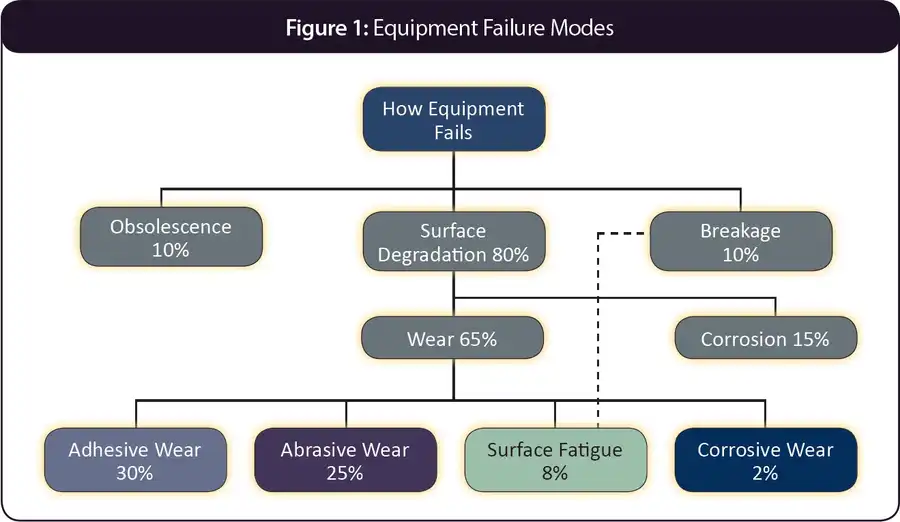
Based on the graph, 80% of the issues that lead to the loss of usefulness of lubricated equipment are due to surface degradation which can be a great opportunity and a great choice as your starting point for your maintenance improvement plans.
Causes of Surface Degradation
• Corrosive Wear
• Surface Fatigue
• Abrasive Wear
• Adhesive Wear
• Thermal Degradation
Corrosive Wear
Acidic lubricants cause the majority of surface corrosion. Oxidation causes lubricants to become acidic. Technicians quantify acidity by measuring the total acid number (TAN) of used oil samples and comparing it with the TAN of fresh lubricant. Oxidation reactions in the lubricant also produce internal deposits of gums, varnish, and sludge. Surface corrosion rarely results from additive reactions. Additive interactions with copper or silver surfaces cause most additive-related corrosion. Elemental oil analysis can easily detect this issue.
Surface Fatigue
Components do not last forever. Over-speed or overload of the equipment, especially in the case of bearings and gear surfaces, causes premature surface fatigue. Doubling the speed reduces bearing life by about 50%, and doubling the load reduces bearing life by about 87.5 percent. Surface fatigue is difficult to detect in operating systems because catastrophic adhesive or abrasive wear caused by large spalling can easily mask it. Detecting wear particles may require partial disassembly and bore scoping by a professional technician. Alternatively, technicians can perform direct-read ferrographic analysis of the wear particles. Definite confirmatory inspection is done by disassembling the machine and inspecting the component with microscope devices.
Abrasive Wear
These particles include wear particles from adhesive wear, dirt, and other abrasive materials originating from the surrounding environment. Technicians can address these issues by regularly checking seals and installing an offline filtration system. To remove pollutants introduced during production and assembly, operators should clean new machinery and systems. To ensure clean, new lubricants, specify the ISO cleanliness requirements, set the standard, and use filtering systems before transferring the lubricant from its container into the reservoir or sump.
Adhesive Wear
The wear of adhesives is caused by metal-to-metal contact. Due to a lack of or loss of the lubricating coating, surface asperities contacting under load while sliding will create heat, friction, and wear. Adhesive wear can range from minor running-in wear caused by a poorly specified break-in oil to damage caused by an entire lack of lubrication on surfaces welded together.
The viscosity of lubricating fluids is its most significant physical characteristic. The viscosity of a fluid is a measurement of its resistance to flow as a function of load, temperature, and speed. The ability of the lubricant to reach the contact zone of the moving surfaces and remain in the contact zone for the required period under the given load to avoid metal to metal contact is determined by its viscosity.
Thermal Degradation
Molecule shearing, reduced viscosity, and polymerization are all caused by the high heat and cracking involved. When molecules shear, they can either volatilize, leaving no deposits, or condense, causing dehydrogenation and depositing lacquer and coke. Reduced viscosity is the major indicator of thermal degradation when compared to increased viscosity during oxidation.
Lubrication FMEA Process
To achieve the full benefits of FMEA, the phrase “lubrication failure” must be defined precisely, because lubricants are critical and mechanical failures are often linked to the lubrication system. To start with the process, register to download Lube FMEA Worksheet.
1. Define the functions of the lubricant that is being investigated.
2. Determine the lubrication-specific failure mechanism that could obstruct the machine’s functional functioning.
3. For each machine, make an X in the boxes where the Lubrication Function and Lubrication Failure Mechanism intersect. Lubricant degradation, for example, can’t affect power and work transmission in a bearing oil system because that function is exclusive to hydraulic machines.
4. Identify the precise lubrication-related failures that are the underlying root causes of failure modes that lead to a loss of system functioning in the Causes, or Failure Mechanisms section. For example, the lubrication failure mechanism “particle contamination induced loss of power and work transfer functionality” might result in a loss of, or degraded, hydraulic system performance, preventing the machine from stamping, molding, and other operations.
5. Complete the FMEA process as described previously.
Technicians can achieve greater maintenance accuracy and improve control over key failure causes by avoiding the careless grouping of unrelated issues under “lubrication failure.” They can also apply a similar deductive approach through the FRCA process to identify lubrication failures more precisely.
If you want to learn more about Failure Mode Effects Analysis due to lubrication issues, CRE Philippines offers a Machinery Lubrication Engineer (MLE) course. Go beyond the standard lubricant and lubrication topics and take a comprehensive approach to planning, executing, and maintaining a world-class lubrication program. This online live training will take place from October 25–30, 2021.
Ready to optimize your lubrication program? Contact CRE Philippines for expert training and solutions! Get in touch today.