

Classifying and Mitigating Lubricant Deposits, misidentifying them may lead to incorrect corrective actions.
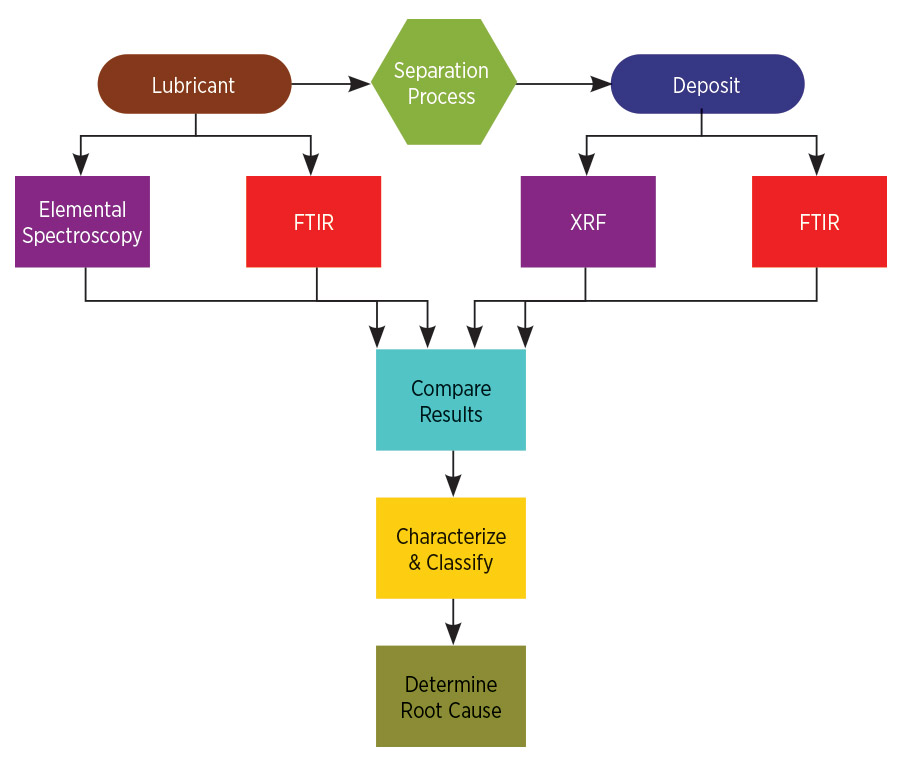
Process of Classifying Lubricant Deposits
Source: Machinery Lubrication
Characterizing Deposits
Characterizing deposits helps us identify the underlying factors that led to their formation. For instance, the composition of deposits can be determined using various testing tools. However, in operational facilities, obtaining samples of deposits for these tests can be challenging. In contrast, collecting a sample of the in-service lubricant is significantly simpler.
Origins of Deposits
To understand the process of classifying and mitigating lubricant deposits, it is important to consider their origin and select the best cleanup strategies. Generally, non-organic deposits do not dissolve in highly polar organic solvents and lack carbon-hydrogen spectral characteristics. Additionally, sludge deposits often contain metal salts of carboxylic acids.
Formation Mechanisms
Lubricant deposits are substances that have left a solution and accumulated within a system. One major cause of such deposits is improper mixing or additive incompatibility. Specifically, if two lubricant formulations are incompatible, one or more additive components may react and form deposits.
Deposit Formation and Lubricant Degradation
Causes of Lubricant Deterioration
There are numerous causes of lubricant deterioration, which frequently result in deposits. Some of the main causes include:
- Oxidation
- Heat Disturbance
- Micro-Dieseling
- Discharge of Sparks
- Zones of Extreme Temperature
- Combustion
- Optical Degradation
- Contamination
- Unsuitable lubricant or other liquids
- Hard and Dirty Substances
- Water
- Gas
- By-Products of Additive Reactions
Source: Machinery Lubrication
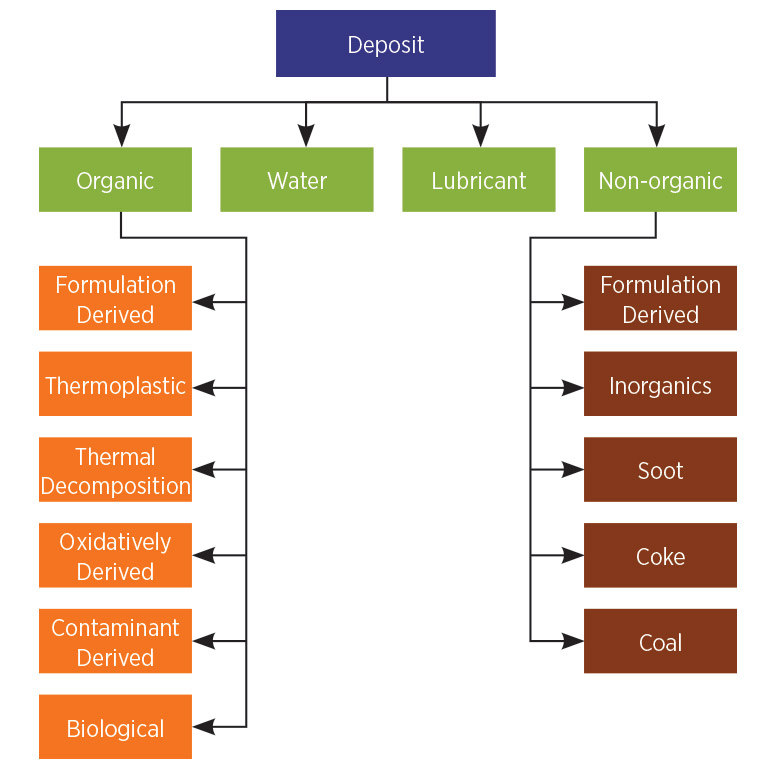
Oxidatively generated deposits are among the most prevalent types of lubricant deposits. Many people wrongly believe that most deposits fall under this heading. These deposits typically have a molecular weight that is higher than the lubricant, which makes it harder for them to stay in the solution.
4. Affected by a Contaminant
When organic pollutants enter the lubricating system, a reaction can happen. An organic contamination deposit can emerge from this reaction. Specific gas pollutants, such as ammonia, can interact with the lubricant to form distinctive organic deposits.
5. Non-Organic Deposits
Deposits that are not organic are also classified as Level 2 deposits. The non-organic classification includes coal and plant matter. Place coal next to these components in the classification tree, as people often mistake it for coke or soot. Together, these two work more effectively to identify the source and, as a result, determine the root cause.
A list of several bins found in non-organic pollutants is given below:
- Inorganics are deposits that lack carbon but contain hard impurities, such as dirt and debris. For example, depleted ZDDP produces phosphate and sulfate deposits, and similarly, degraded additives can form inorganic deposits. As a result, these deposits may accumulate over time and reduce engine performance.
- Soot – Black carbonaceous particles smaller than one micron form soot, often after a dieseling event in diesel engines. These particles may appear in high-temperature areas and require special equipment for removal.
- Coke – Carbonaceous deposits larger than one micron form coke when organic material overheats (above 572°F / 300°C) and expels all hydrogen and oxygen.
- Coal – Black carbonaceous solids larger than one micron form coal deposits. However, they remain soluble in some polar organic solvents, such as tetrahydrofuran or pyridine.
Root Cause Analysis
According to Machinery Lubrication, a thorough investigation of the deposit is frequently the first step in identifying the fundamental problem. The fluid’s general state reveals a great deal about the direction of creation. One can focus efforts on the elimination and removal of deposits after identifying the fundamental cause of the issue. (Classifying and Mitigating Lubricant Deposits)
Oil Analysis Through MachineDiagnostics™ Program
For assets that are prone to varnish deposit formation, a thorough and regular checkup must be done to manage and mitigate the issue. Start your oil analysis program with confidence, knowing that we’ll be there for you every step of the way.
Our program addresses your system’s requirements, trains your staff on optimum lubrication techniques, and provides actionable recommendations to help you achieve greater uptime. Every time you require a more thorough explanation or consolidation reporting, you can trust that our lube analysts and machinery lubrication consultants are there to help you. Talk to us and we will do a free assessment on your assets!