

The designs of many common machine mechanisms have stayed the same for decades. Machine designers working for Original Equipment Manufacturers (OEMs) believe lubrication may improve.
There are new machines created today based on this incorrect notion. Several wet-sump oil systems have visible evidence in pumps, gears, and bearings.
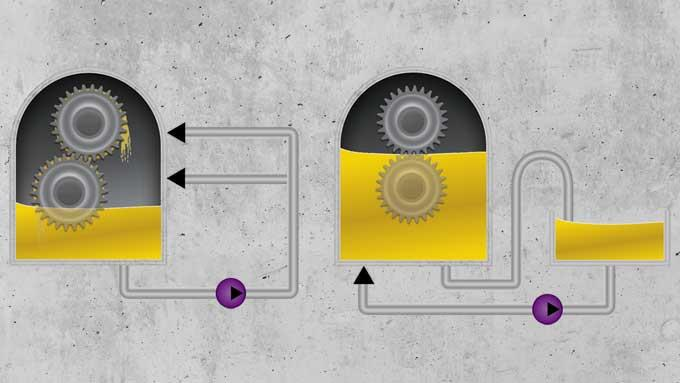
Several non-circulating bearing and gear sumps that feed oil to frictional surfaces are good examples. These are Wet-sump Lubrication (WSL) systems that use one of the following methods to deliver lubricants:
- Climbing-Oil Lubrication – the rotation of gears in a wet sump lift adhering oil into gear mesh zones.
- Flood Lubrication – oil is used to immerse frictional surfaces.
- Oil Ring/Collar Lubrication – oil is lifted to the top of channels and grooves by spinning rings and collars, where gravity feeds it into bearings.
- Slinger/Flinger Lubrication – moving objects toss oil to troughs and frictional zones.
- Splash Lubrication – gear movement through an oil sump causes a splash or mist to spread throughout the gear set, wetting machine surfaces.
All these methods provide little more than a primary lubricant supply. Today’s reliability organizations demand more than this, especially for machines prone to failure or with high machine criticality. Retrofitting an oil circulation unit to an existing wet-sump system is a simple upgrade many users may make.
Users and machine designers only sometimes understand circulation benefits. This is one of the reasons why OEMs and customers alike reject the extra cost of oil circulation as a required investment.
Oil circulation systems are classified into four types:
- Oil-feed Circulation – a wet-sump system that directs lubricant to lubricated surfaces by pumping oil from the sump through lines.
- Constant-level circulation – uses a small external reservoir and the machine’s wet sump.
- Offline circulation – is a simple kidney-loop system that controls offline filtration and temperature.
- Hydraulic system – a flooded system in which frictional surfaces contact the circulating oil.
Hydraulic and oil-feed circulation are complex systems in design and production. But, consumers may get many benefits from oil circulation by adding constant-level and offline circulation to most WSL machines.
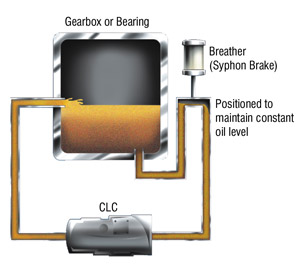
This is an illustration of a constant-level circulation (CLC) system.
Benefits
As mentioned, many benefits of oil circulation are subtle or need to be more understood. Yet, they are critical to machine dependability. Some of the benefits of oil circulation are detailed in further detail below for a better understanding:
Contamination Control
It is not easy to maintain oil cleanliness and dryness without onboard. Filtering necessitates oil circulation, which wet-sump lubrication does not provide. The only other option would be to use portable filter carts to clean the oil and flush the sump.
Include onboard filtration in both constant-level and offline circulation systems for superior performance. Filtration has the extra benefit of reducing pollutant levels even when the machine is idle.
Minimal Risk of Sediment and Free Water
Flowing oil disrupts settling zones, which allow sludge and silt to collect. The filter traps these pollutants instead. Many wet-sump systems accumulate more sediment than oil in the sump, which is hard to detect. Sediment can be disturbed by machine movement, oil turbulence, and oil drain-and-refill processes.
The fishbowl effect, which causes disturbed sediment to travel to critical zones in the machine, can cause unexpected machine failure. Water vapor is also released into the environment when oil is circulated. Water puddles on the sump floor in simple wet-sump systems over time.
New Oil Filtration
Fresh oil transported to a wet sump often comes unfiltered from a dirty transfer container. Constant-level circulation systems force all incoming oil to pass through a filter. If there is ambiguity on the purity of fresh oil, this ensures a higher level of contamination control.
You can equip offline circulation systems with quick-connects and valves, letting new oil pass through the filter before entering the sump.
Oil Volume Benefits
Filters and piping add fluid to the circulating system. When, for example, you have twice as much fluid, you have twice as much additive, half as many contaminants, half as much wear metal, half as much thermal damage to the oil and a lower oil temperature.
Use a constant-level circulation system with an external reservoir instead of an offline system to gain the benefits of higher oil volume.
Oil Analysis Program
Establishing maintenance plans to detect early equipment failure through oil analysis is costly. As a result, you must prepare carefully to ensure you use your resources efficiently.
With CRE, you can start your MachineDiagnostics™ Program, knowing you will have our full support at every step. Our package includes a complimentary lecture, Machine Wear Analysis Basic Seminar, to ensure your employees know the optimal lubrication techniques. We also have a dedicated support team that handles all your concerns on our reports. You will also have easy access to the advice of our capable and certified Lube Analysts and Machinery Lubrication Consultants whenever you need more in-depth explanations and comprehensive, actionable recommendations.
CRE Philippines also offers a test package called Gear Check™ 884. The package tests the condition of oil, contamination, and wear. It also includes special tests on double wear checks and ferrographic analysis to help you narrow down the root cause of gear problems. Contact us here to know more.