



Amid today’s evolving industrial landscape, where machinery is central to manufacturing and transportation sectors, the significance of optimal machine functionality cannot be overstated.
This significance finds its audience among maintenance professionals, the unsung heroes responsible for the seamless operation of these mechanical giants. Amidst the multifaceted realm of machinery maintenance, there exists an often-underestimated facet – lubrication, a fundamental process that stands as the vanguard against friction-induced wear and tear
The Greater Significance of Small Particles
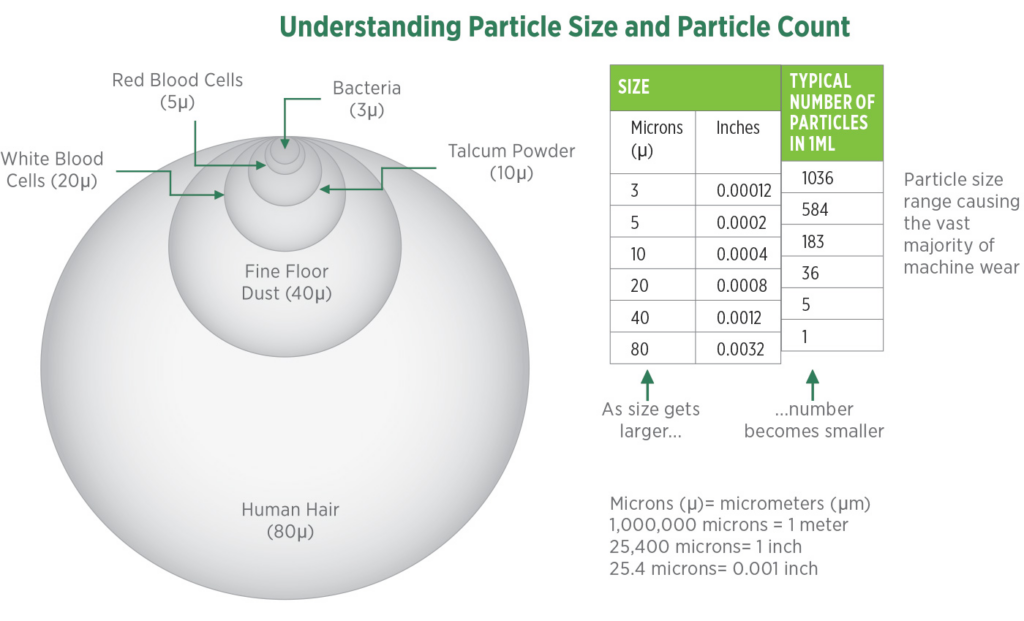
In machinery lubrication, particle size in the fluid is often overlooked, yet it critically affects machinery health and performance. Small particles, often invisible to the naked eye, have the potential to cause significant disruptions in machinery operation.
The Impact of Particle Size
Understanding the impact of particle size begins with realizing that smaller particles can penetrate the tightest clearances and crevices within machinery components. These particles can exert mechanical stress on surfaces, increasing wear and catastrophic failures over time. As machinery components wear down, the entire system’s efficiency diminishes, resulting in decreased productivity and higher maintenance costs.
The Intricacies of Particle Ingestion
Particles aren’t only external contaminants; they can also be generated within the machinery. Dust, rust, and debris contaminants can infiltrate lubrication systems and accumulate over time. The lubricant ingests these particles and is transported throughout the machinery, wreaking havoc on delicate components. As particle concentration increases, the potential for machinery malfunction rises.
Unraveling the Consequences
The ingestion of particles doesn’t only lead to physical wear and tear. It can also instigate chemical reactions that degrade the lubricating fluid’s quality. As lubricants break down, their ability to provide adequate lubrication diminishes, putting more stress on machinery components. This vicious cycle can result in a cascading effect, leading to accelerated machinery deterioration.
The Role of Mechanical Processes
Mechanical processes within machinery, such as friction between moving parts, can generate particles of various sizes. Often, microscopic particles can combine with lubricating fluids to form abrasive compounds. Over time, these abrasive compounds exacerbate machinery wear, causing premature failure and decreased efficiency. Particle counting becomes essential in such scenarios, as it enables maintenance professionals to track and mitigate the effects of these particles.
Are Your Machines Experiencing Problems?
In the grand tapestry of machinery maintenance, particle counting within lubrication systems emerges as a cornerstone of paramount importance. The subtle nature of small particles belies their potential to wreak havoc on machinery components. By understanding how particle size affects machinery and using effective particle counting techniques, maintenance professionals can prevent breakdowns and extend equipment lifespans. Whether overseeing an expansive manufacturing domain with robust machinery or managing a fleet of vehicles traversing vast distances, the wisdom drawn from particle counting resonates.
Regular analysis and vigilant particle monitoring can prevent emerging issues, reduce unplanned downtime, and control maintenance costs.
Even the tiniest particles can cause significant disruptions in machinery lubrication. Implementing a holistic particle counting strategy goes beyond risk mitigation—it fosters a culture of proactive maintenance and ensures machinery operates at peak efficiency.
As you maintain your equipment, remember that microscopic particles can have a major impact. Embrace particle counting as a key tool in your maintenance practices to keep machinery performing optimally.
For those seeking a comprehensive oil analysis program, the CRE MachineDiagnostics™ Program provides an opportunity to enhance maintenance practices, improve reliability, and increase efficiency. Contact us to take your maintenance program to the next level.
Source:
Richardson, T. (2022, June). Particle Counting: Why Smaller Particles Lead to Big Trouble. Machinery Lubrication. https://www.machinerylubrication.com/Read/32156/particle-counting-why-smaller-particles-lead-to-big-trouble-