

Learn how maintenance can be optimized through advanced oil analysis techniques, including particle counting. By incorporating particle counting into your maintenance practices, you can enhance equipment performance and extend machinery longevity. Ask yourself: are you leveraging innovative maintenance strategies to maximize the efficiency of your equipment?
Oil analysis is essential to ensuring the effectiveness of maintenance because it provides the foundation for efficient machinery operation. In particular, particle counting enhances equipment maintenance procedures. Using advanced oil analysis techniques, engineers can proactively identify maintenance needs, which in turn reduces downtime and boosts productivity.
Track Internal Conditions from the Outside
Oil analysis is a crucial maintenance tool for monitoring and assessing the condition of lubricants and equipment. In addition, it helps identify issues, prevent fatal failures, and increase equipment reliability. Through testing and analysis, technicians gain important details about the condition of both the equipment and the oil. Consequently, unchecked wear particles and contamination, if overlooked, can severely impact equipment performance and reliability. Moreover, oil analysis helps identify the underlying causes of equipment problems, including irregular wear and lubricant deterioration, which can ultimately lead to component failures.
Predict Maintenance
The outcomes of oil analyses are essential for predictive maintenance plans. They offer early warning signs of possible problems. These are component failures, excessive idling, and fuel dilution. By monitoring trends in oil properties, you can detect declining conditions, higher contamination levels, and lubricant degradation. Creating a trending history of oil analysis for equipment components allows you to predict when maintenance activities such as oil changes, filter replacements, and component repairs will be needed before issues worsen and cause failures.
Value of Oil Analysis: Beyond Testing
Accredited laboratories conduct standard oil analysis tests. The tests includes Fuel Dilution, Nitration/Oxidation, Acid Number/Base Number, Viscosity, Particle Count, and Elemental Analysis by ICP. These tests provide equipment users with test results, a review by a Data Analysts team, and maintenance recommendations. A successful oil analysis program has the greatest return on investment (ROI) when it accurately interprets sample test results and acts timely.
The oil analysis sample report includes numerical test results. These results consist of:
- Wear metals
- Contaminant metals
- Multi-source metals
- Additive metals
- Contaminants (fuel, soot, water)
- Fluid properties (viscosity, acid number, base number, oxidation, nitration)
A data analyst reviews the results and flags the results based on severity for each data set.
Particle count is a crucial test for assessing fluid and system cleanliness in filtered systems. These are:
- Hydraulics
- Turbines
- Compressors
- Auto/power-shift Transmissions
- Recirculation Systems
- Filter gear systems with a fluid viscosity of ISO 680 or less
Particle analysis measures all particles accumulated in a system, including metallic and non-metallic particulates, dirt, fibers, and biological growth. To achieve this, several test techniques are available for measuring particles in used lubricants, though results can vary depending on the instrument or laboratory. One widely used approach, the Automatic Particle Counting method, determines the number of particles in a sample using a device that combines a laser and sensor. Typically, the results are reported as the particle count per milliliter at different micron sizes.
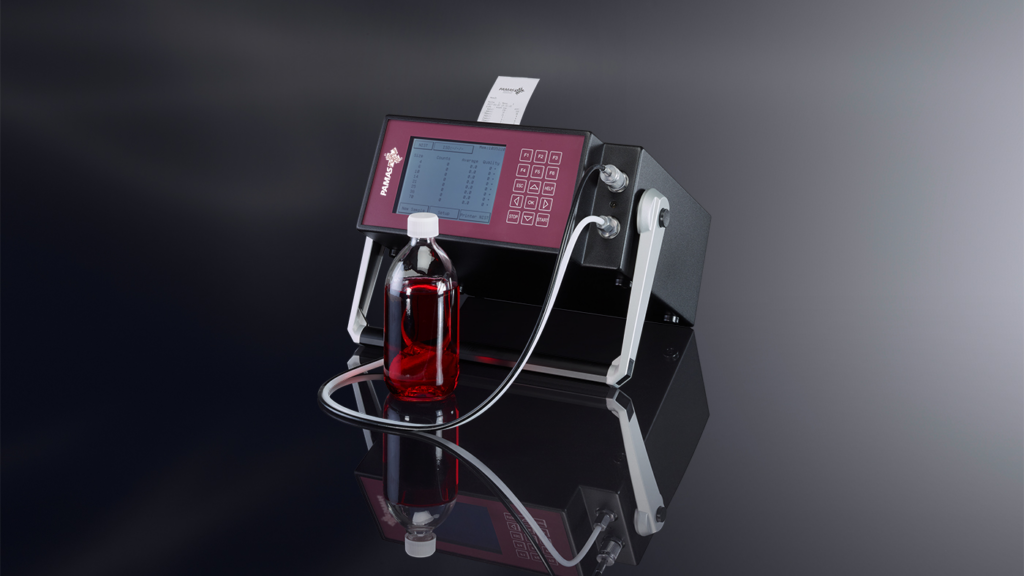
PAMAS S40 is a portable particle counting system for oil-based liquids like hydraulic and lubricating oil.
Particle Quantifier
Particle quantifying (PQ) is the preferred test method for measuring the concentration of sizeable ferrous wear particles in used lubricants. PQ measures the density of ferrous debris without a particle size limitation. It assigns a value based on the metallic content in the sample. When used with AES-ICP, comparing PQ results with ICP results can reveal the severity of abnormal wear events. The ICP can detect smaller wear sizes but has limitations with larger particles (> 7µm). Further testing can help identify contamination sources and assess component damage.
Wear trends can be detected by tracking iron concentrations using elemental metals analysis (ICP) and particle quantifier. It warns operators in advance of possible issues. This prompts the laboratory to test the lubricant sample using analytical ferrography. This is done to specify the type and level of wear. A qualified analyst performs analytical ferrography. It gives more detailed information about contamination or mechanical wear. It offers an organized plan of action when paired with additional elements such as viscosity, acid number, PQ, metals analysis, and water content.
Analytical Ferrography
Analytical Ferrography is a method that identifies and characterizes wear particles suspended in lubricating oils. Specifically, it provides detailed information about particle size, shape, composition, and distribution. To analyze these particles, technicians review a ferrogram, which is a slide prepared from the oil sample. First, they collect ferrous objects from the oil and pour the sample through a tube onto a glass slide suspended over a magnet. Next, they rinse off the oil, soot, dirt, and other debris, leaving the ferrous wear visible under a microscope for detailed examination.
An analyst can view the various wear mechanisms in the oil by examining a ferrogram. Unlike some other testing methods, this method does not depend on the size of the wear particles. Technicians can easily identify both large and small wear, as well as hints of potential causes.
Filter Debris Analysis
Oil filters in equipment systems remove contaminants and particles. Moreover, they capture evidence that can help identify system wear and contamination. To analyze this evidence, the Filter Debris Analysis process removes particulates from filter media and isolates them for laboratory testing. This process involves preparing a filter patch of debris, conducting ferrography, and testing the elemental metal in any oil that arrived with the filter. Next, a trained ferrographic analyst can identify the particulates’ type, size, and shape. When combined with routine oil analysis testing, this approach allows maintenance teams to identify the root cause of equipment wear or catastrophic failure.
Oil Analysis as a Tool for Predictive Maintenance
An essential technique for identifying abrasive particle contamination in lubricating oils is oil analysis. By enabling prompt maintenance and corrective action, it increases equipment longevity and helps prevent performance and reliability problems. Furthermore, it ensures that the necessary corrective actions are carried out effectively.
In conclusion, maintenance is critical for optimizing equipment performance and ensuring longevity. By integrating oil analysis techniques, such as particle counting, into maintenance protocols, engineers can proactively identify potential issues. As a result, this approach minimizes downtime and maximizes productivity.
CRE Philippines understand the critical role that maintenance plays in equipment reliability. We provide innovative Machine Diagnostics Program and MLA II Oil Analysis Training.
The CRE Oil Analysis Program is a comprehensive initiative designed to enhance equipment reliability through advanced oil analysis techniques. By regularly analyzing oil samples, the program helps identify potential issues such as contamination, wear, and lubricant degradation. As a result, this proactive approach allows businesses to anticipate equipment failures, reduce downtime, extend equipment lifespan, and improve overall operational efficiency.
Similarly, MLA II oil analysis is designed to provide thorough insights into the health of your machinery. To support this goal, the training covers an introduction to machinery lubrication, oil analysis fundamentals, oil sampling best practices, contamination control, and fault detection and wear particle counting. By applying these techniques, you can not only optimize your maintenance procedures but also help your equipment achieve its maximum potential.
Contact us to maximize the performance of your equipment and transform your maintenance procedures.
Source:
Debshaw, B. (July 2023) Enhancing Equipment Performance: The Role of Oil Analysis and Particle Counting. Machinery Lubrication.